
CBD Dosage for Dogs: Reading Labels & Measuring Oil

How much CBD should you give your dog? There is no single dose we can recommend for every dog or every product. Before using CBD, ask your veterinarian whether it is appropriate for your pet and, if so, what amount and schedule to follow. A bottle's total milligrams and your dog's weight alone do not answer those questions.
This guide explains how to read a CBD label, distinguish milligrams from milliliters, and prepare useful questions for your veterinarian. It does not prescribe a dose or replace veterinary care.
Updated September 6, 2026.
Start with your veterinarian and the complete product label
The FDA has not approved cannabis for use in animals and cannot assure the safety or effectiveness of these products. It recommends discussing appropriate treatment options with your veterinarian.
Bring your pet's current weight, age, health history and list of medicines and supplements, along with the product label and any matching laboratory report. Ask:
- Is this specific product appropriate for my dog, given their health and current medicines?
- If you recommend it, what CBD amount in milligrams and oil volume in milliliters should I measure, and how often?
- What changes should I record, when should we review progress, and what would mean I should stop?
- Would any examination or blood testing be appropriate?
Do not replace prescribed treatment or increase an amount simply because you have not noticed a change. Confirm any adjustment with your veterinarian.
Understand CBD milligrams, bottle volume and concentration
Milligrams (mg) describe an amount of CBD. Milliliters (mL) describe the volume of liquid. A bottle labeled with a total CBD amount does not contain that amount in every dropper or pump.
For a liquid labeled with both total CBD and bottle volume, the label-based calculation is:
Total CBD in the bottle (mg) ÷ bottle volume (mL) = CBD concentration (mg/mL).
Measurement example only: a hypothetical 300 mg CBD bottle containing 30 mL of oil has a labeled concentration of 10 mg/mL. A measured 0.25 mL portion would therefore contain 2.5 mg CBD. These numbers illustrate the units; they are not a recommended dose or specifications for an Urban Roots product.
Once your veterinarian has specified a CBD amount, the corresponding volume is that amount in mg divided by the verified concentration in mg/mL. Ask them to confirm the calculation and measuring device. Do not assume one drop, one squeeze, a full dropper or a pump has a standard volume.
Also check what the label's number measures: CBD, total cannabinoids and hemp extract are different descriptions. Do not substitute a hemp-extract total for a stated CBD amount. A laboratory result in mg/g is a concentration by mass, not automatically mg/mL or mg per serving. Our guide to reading a CBD certificate of analysis explains the units and report limits.
What does research tell us about dosing?
Researchers have studied particular CBD formulations in dogs, but a research protocol is not a universal dosing chart. In a small 2018 controlled trial in dogs with osteoarthritis, some pain and activity measures improved, while an increase in a liver-associated enzyme was also reported. The study's small sample and short treatment periods limit what it establishes.
A 2019 preliminary study in healthy dogs and cats examined different formulations and monitored repeated use for 12 weeks. It does not establish that every retail product is safe for every pet. Neither study tested Urban Roots products, and neither validates a general dose for your dog.
Safety, unexpected effects and accidental ingestion
CBD products should not be described as harmless or impossible to overdose on. If your pet becomes unwell after a cannabis product, or you suspect an excessive or accidental ingestion, contact your veterinarian, an emergency animal hospital or animal poison control promptly. Keep the package available so they can identify the ingredients and amount.
The FDA lists signs of adverse effects from cannabis ingestion including unusual lethargy, heavy drooling, vomiting, agitation, tremors and convulsions. Do not wait for a planned trial period to finish if your pet develops concerning symptoms.
Check the entire ingredient list before sharing anything made for people. In particular, xylitol can poison dogs and appears in some sugar-free foods, supplements and peanut butters. Keep cannabis products and other potentially harmful ingredients out of pets' reach.
Common questions about CBD for dogs
Can I give my dog CBD every day?
Do not infer a suitable daily schedule from the bottle size or a general online chart. Ask your veterinarian whether use is appropriate, how to monitor it and when to reassess. Published studies involve specific animals, products and observation periods.
How long does CBD take to work?
There is no reliable onset promise we can make for your dog. Blood concentration, visible changes and a meaningful health outcome are different measurements. Arrange a review plan with your veterinarian instead of increasing the amount to chase a rapid effect.
Can I use the same guidance for cats or puppies?
Do not transfer an adult dog's plan to another species or life stage. Ask your veterinarian about the individual animal and the exact formulation.
Is full spectrum or isolate better for my dog?
Those labels describe the extract, not a veterinary recommendation. Compare the stated cannabinoids, THC information, complete ingredients and matching report with your veterinarian. A “pet” label alone is not evidence of safety, and a report's “not detected” result has a detection limit.
Compare Urban Roots pet product information
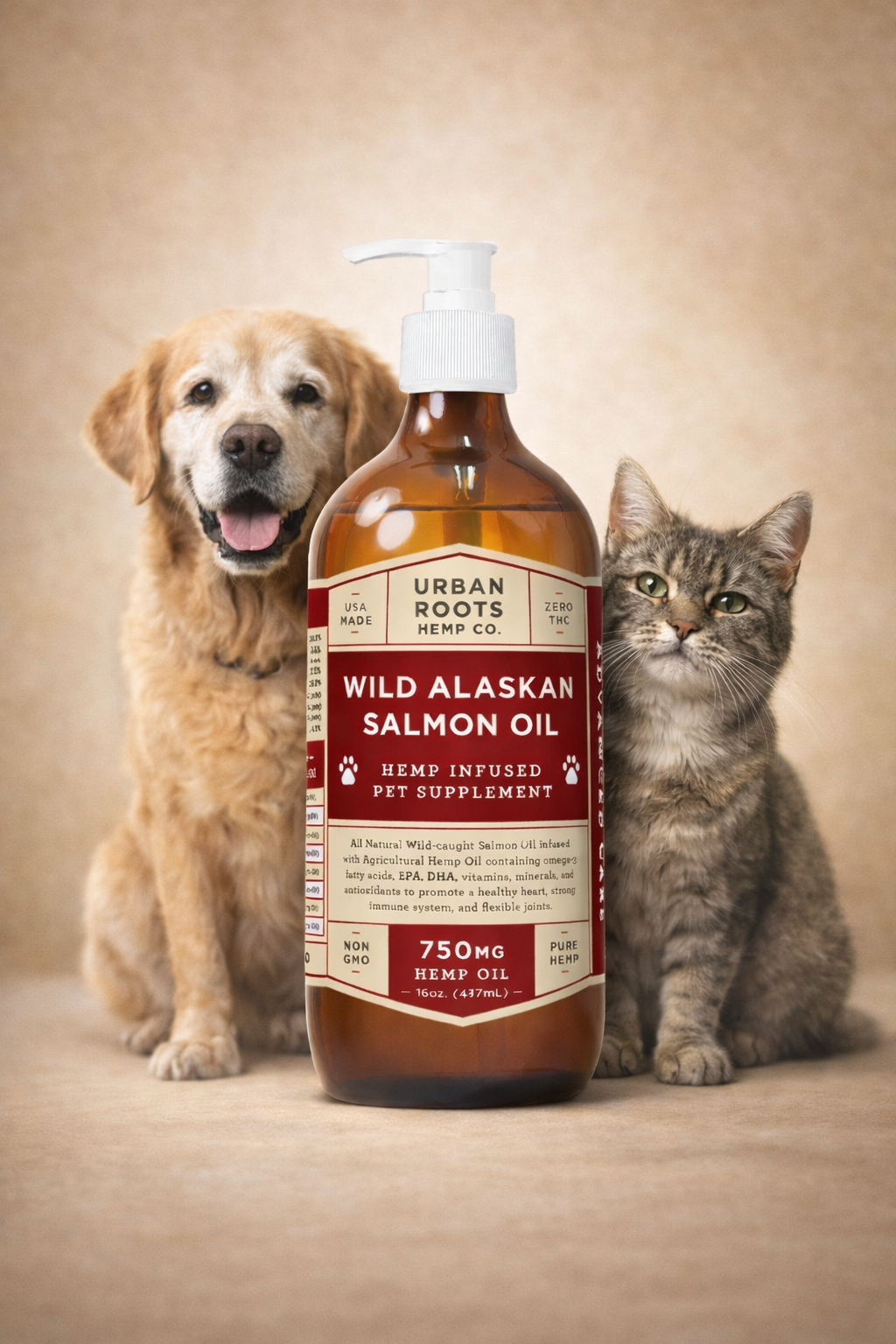
Our pet product guide brings together pet tinctures and CBD-infused salmon oils so you can compare formats and current label information. Review the available laboratory reports alongside the bottle you have. A report applies to its identified sample and tests; it does not establish a suitable dose.
If a concentration, pump volume or current report is unclear, contact Urban Roots for product information before measuring it. Your veterinarian should guide medical suitability and dosing.